"Don't Say It!": Constraints, Compliance, and Communication when Language Models Play Taboo
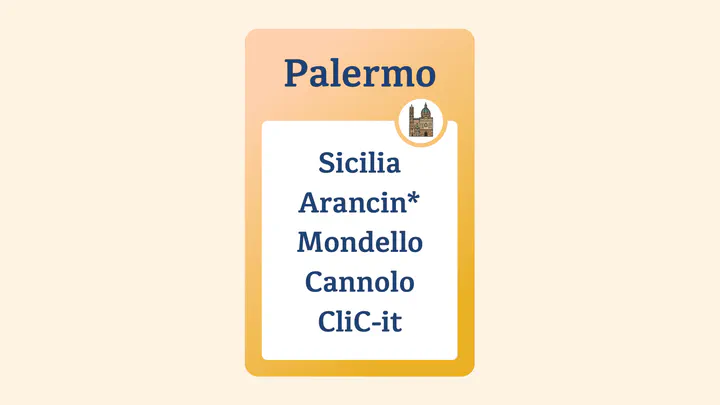 A Taboo card from our CLiC-it oral: describe Panella without saying Cecina, Frittella, Ceci, Palermo or Sicilia.
Abstract
In Taboo, a player must describe a target word without using a list of forbidden words, so that others can guess it. The game combines a hard lexical constraint with the need to be communicatively effective, which makes it a natural testbed for language models. Using 194 Italian Taboo cards, we evaluate gemma-3-4b-it and gpt-oss-20b (with and without reasoning) under interventions at three depths of the generative process: prompting, generation-time constraints (static token bans and an online backtracking decoder), and steering the residual stream away from sparse-autoencoder features of the forbidden words. We measure rule violations, use LLM judges to estimate how strongly each description evokes the target, and run a human study in which people guess from model descriptions and models guess from human ones. Prompting reaches high compliance but produces sparse descriptions; constrained decoding yields the most guessable descriptions for humans at the cost of occasionally leaking the target; SAE steering keeps descriptions informative but breaks the rules far more often. As guessers, models need 5 to 10 attempts to approach what humans achieve on the first try.
Type
Publication
Twelfth Italian Conference on Computational Linguistics (CLiC-it 2026)
Key findings
- Explicit constraints work. Without being told the forbidden words, models break the rules in about two thirds of cases. Prompting raises compliance above 90% for Gemma and for gpt-oss with reasoning, and constrained decoding reaches up to 98.5%.
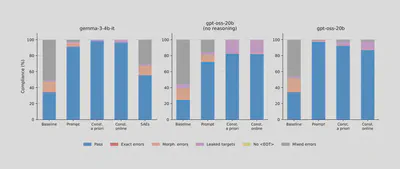
- Reasoning helps follow the rules. gpt-oss-20b goes from 72% to 97% compliance under prompting when chain-of-thought is enabled.
- How you constrain shapes what the model says. Constrained decoding pushes models toward more precise paraphrases, and human guessers do best on these descriptions (38% vs. 23% for prompting). SAE steering keeps descriptions informative but often violates the rules and switches language.
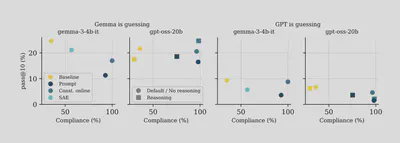
- Models are weak guessers. Even the better judge needs 5 to 10 guesses to approach human first-try accuracy.